Last updated: October 2026
Quick answer
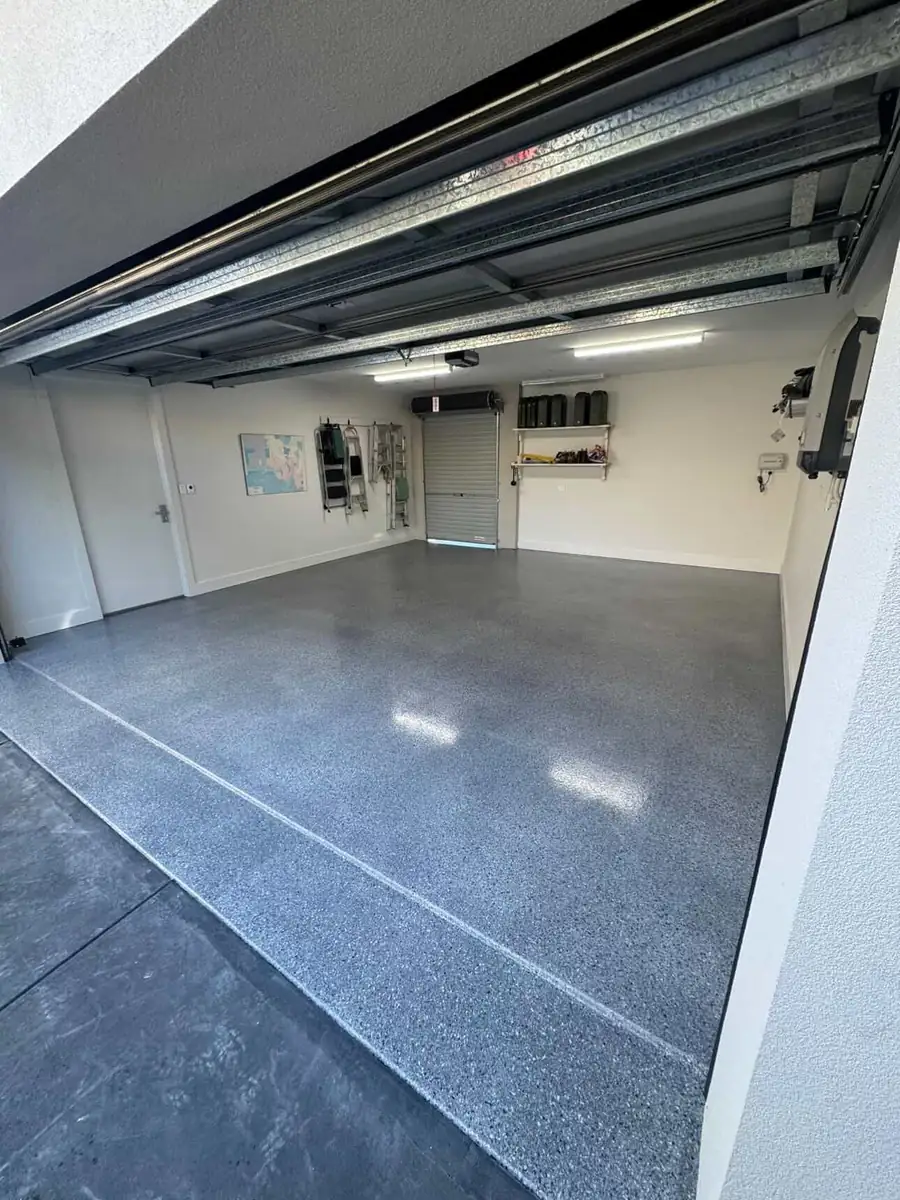
Garage epoxy flooring in Adelaide is a seamless resin coating applied to a diamond-ground garage slab, usually with a full flake broadcast and a hard, UV-aware topcoat. Done properly it resists hot-tyre pickup, oil and dust, cleans with a mop and suits Adelaide's hot summers and damp winters. Most single and double garages take one to three days, and every quote starts with a free on-site look at the slab.
Why Adelaide homeowners coat their garage floors
A bare garage slab is porous. It soaks up oil and brake fluid, sheds fine concrete dust onto everything stored in the garage and shows every tyre mark. In Adelaide there is an extra problem: hot rubber. Cars driven on bitumen on a 38-degree afternoon come home with soft tyres that can lift weak coatings and leave black marks on bare concrete. A professionally installed garage epoxy floor seals the slab, gives it a hard wear surface and turns the garage into a space that is easy to clean and pleasant to use as a workshop, gym or storage area.
Most of our garage work is in suburban homes across greater Adelaide: double garages in the northern and southern suburbs, compact inner-city garages in places like Norwood and Unley, and larger garages and sheds in the Hills and around Gawler. The basic system is the same, but the preparation and topcoat change with the slab and how much sun the doorway gets.
What a professional garage epoxy system includes
- Site assessment. We check slab age, cracks, old coatings, oil contamination and signs of rising moisture, and measure the floor.
- Diamond grinding with dust extraction. This opens the concrete surface so the coating keys in, and removes laitance, sealers and old paint.
- Repairs. Cracks, spalls, control joints and old fixing holes are filled so they do not show through.
- Base coat. A pigmented epoxy is rolled at a controlled thickness and bonds to the prepared slab.
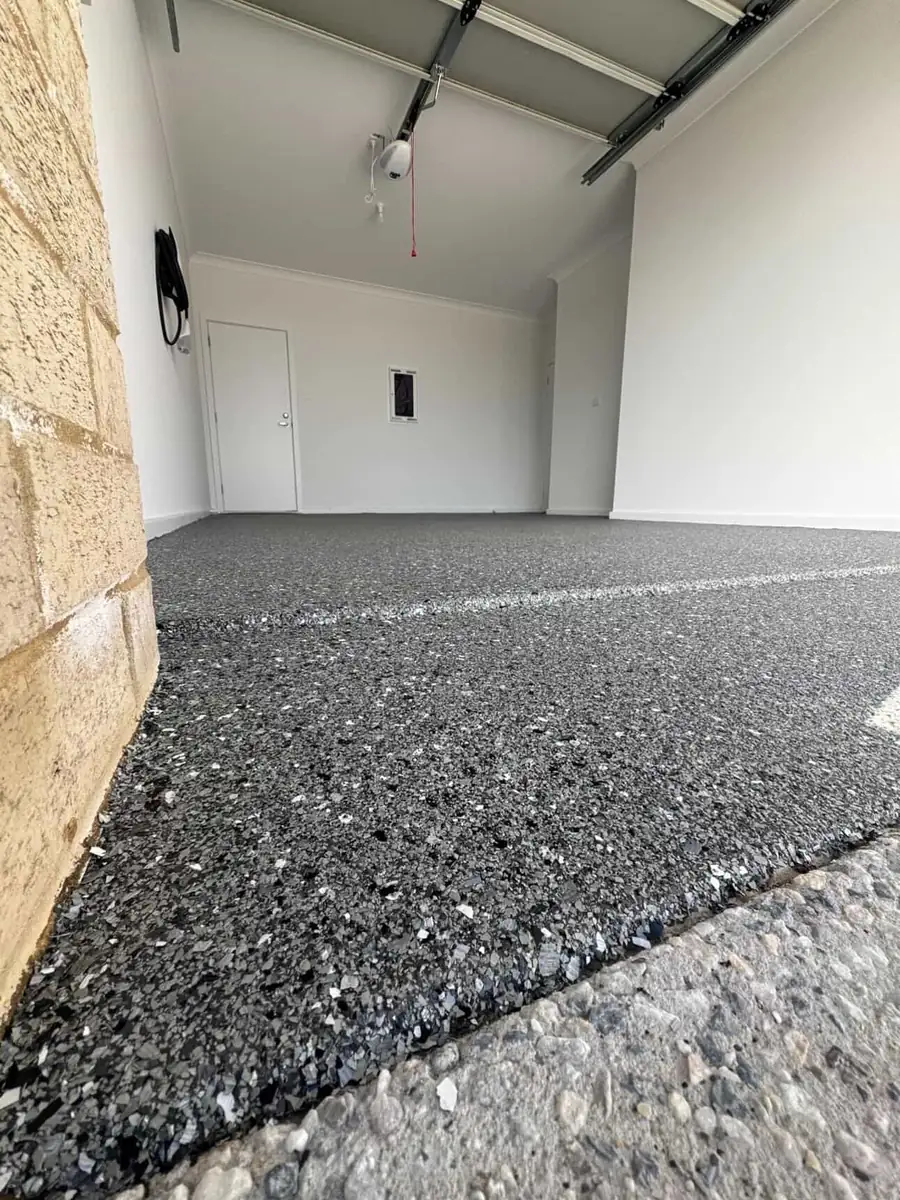
- Flake broadcast. Coloured vinyl flakes are broadcast to full coverage for texture and dirt-hiding.
- Topcoat. One or two clear coats lock in the flake. Where sun hits the floor, we use a UV-stable topcoat such as polyaspartic.
- Cure and handover. You get written walk-on and vehicle-return times plus care instructions.
Garage floor options compared
| Option | Durability | Hot-tyre resistance | Look | Good for |
|---|---|---|---|---|
| Bare concrete | Dusts and stains | Marks easily | Grey, patchy over time | Unused or temporary spaces |
| Garage floor paint / DIY kit | Months to a few years | Often peels in tyre tracks | Flat colour | Rentals, light storage, short-term budgets |
| Professional flake epoxy | Many years with correct prep | Designed to resist | Speckled, textured | Everyday family garages |
| Metallic epoxy | Many years indoors | Good with a hard topcoat | Glossy marble effect | Show garages and studios |
| Polyaspartic topcoat over epoxy | Hard-wearing | Strong | Clear, UV-stable | Sun-exposed doorways, faster return to service |
For a deeper comparison, read epoxy vs garage floor paint, epoxy vs polyaspartic and flake vs metallic epoxy.
Adelaide conditions that affect a garage floor
Three local factors come up on almost every garage job. The first is heat: a closed garage can sit far above the outside temperature, so we start early, keep resin out of the sun and avoid coating a hot slab, which shortens working time and can leave a patchy finish. The second is UV: a west-facing garage with the door open in the afternoon exposes the first metre of floor to strong sun, and standard epoxy clear coats can yellow there, so we use a UV-stable topcoat. The third is Adelaide's reactive clay. Many suburbs sit on soils that swell and shrink with the seasons, which is why so many garage slabs have cracks. We repair them and explain honestly which lines may reappear as hairline marks. The Adelaide climate guide covers all three in more detail.
Choosing colours and finish
Mid-tone flake blends with a mix of greys, blacks and whites hide dust, tyre marks and dropped leaves best. Very pale blends look bright on day one but show dirt sooner, and very dark blends show dust and scratches. If the garage doubles as a gym or workshop, think about grip and how easy it is to spot a dropped screw. We bring sample boards and recommend looking at them in the garage's own light. If you want a showpiece rather than a working floor, the metallic epoxy page shows the alternative.
Preparing for your garage install
- Empty the garage completely, including shelving that is not fixed to the wall.
- Tell us about any oil stains, old paint or past coatings so we can plan removal.
- Plan where cars will park for the cure period, which we give you in writing.
- Keep pets and children out of the garage while coatings cure.
- Ask for the written scope: preparation, number of coats, flake coverage and topcoat type.
The step-by-step timeline is on how an epoxy job works, and prep and warranty lists the questions worth asking any contractor. For budgeting, the epoxy flooring cost guide gives labelled typical Australian ranges.
Garage epoxy across Adelaide
We coat garages throughout metropolitan Adelaide and travel across South Australia, including Salisbury and the northern suburbs, Mount Barker and the Adelaide Hills, Gawler and the Barossa, Marion, Noarlunga, Glenelg, Port Adelaide, Modbury, Norwood and Unley. Call or text 0421 443 213 or use the quote form for a free on-site quote.
How long before you can walk, park and move back in?
Return to service depends on the resin chemistry, the slab temperature and the humidity on the day, not on the calendar. The table shows typical industry ranges for a residential garage so you can plan; your written schedule from the site visit is the one to follow, and cooler winter days push every stage later.
| Stage | Epoxy base with epoxy clear coat | Epoxy or polyaspartic base with polyaspartic topcoat |
|---|---|---|
| Light foot traffic in clean socks or shoes | Usually 12 to 24 hours | Often 4 to 12 hours |
| Moving boxes, bikes and shelving back in | Usually 48 to 72 hours | Usually 24 to 48 hours |
| Parking a car | Usually 5 to 7 days | Often 24 to 72 hours |
| Full chemical resistance (oil, brake fluid, cleaners) | About 7 days | About 5 to 7 days |
What "one-day garage floor" offers really mean. Fast-curing polyaspartic and polyurea coatings can be ground, repaired, coated and topcoated in a single day on a sound, dry slab. That is a real option, not a gimmick, but the speed comes from the chemistry, not from skipping steps. On a hot Adelaide day those products have a very short working time, so the crew, mixing and preparation have to be right. If a quote promises one day, ask what the grinding, crack repair and moisture checks look like, and when you can actually drive on the floor.
Measuring your garage: single, double and larger
Most quotes start with the floor area, so it helps to know roughly what you have. A typical Australian single garage is around 3 m by 6 m (about 18 m²), a standard double is roughly 6 m by 6 m (about 36 m²), and a long double or triple garage can reach 54 m² or more. Measure wall to wall inside the garage, and include any step-down to a laundry, the threshold under the roller door and any storage alcove you want coated.
Area is not the whole story. Grinding the edges, cutting in around posts and repairing cracks takes about the same time on a small garage as on a big one, which is why small garages usually cost more per square metre. Old paint, oil-soaked patches and badly cracked slabs add preparation time regardless of size. The epoxy flooring cost guide explains these drivers with labelled typical Australian ranges.
Moisture, older slabs and garages in the Adelaide Hills
Moisture coming up through the concrete is the most common reason a well-applied coating still blisters. The risk is higher in older homes whose slabs may not have a plastic membrane underneath, in sheds and garages on sloping Hills blocks where rainwater runs toward the door, and in garages that double as a laundry. Warning signs include dark patches that appear after rain, white powdery salts (efflorescence) along joints, and old paint that bubbled rather than wore through.
A quick indicator is the plastic-sheet test: tape a square of clear plastic to the slab for a day or two and look for condensation or darkening underneath. A more reliable method is an in-slab relative humidity probe, which measures moisture inside the concrete rather than just at the surface. Where readings are high, a moisture-tolerant epoxy primer is applied before the normal system, or we tell you plainly that the slab is not a good candidate for a coating. You hear that before you get a price, not after the floor fails.
Using the garage as a gym, workshop or hobby space
- Home gym: rubber mats sit happily on epoxy, but dropped plates and kettlebells are point impacts. A lifting platform or thick rubber tiles where weights land protects both the coating and the slab.
- Car and bike work: jack stands, trolley jacks and motorbike side stands concentrate weight on a tiny area, and on a 40-degree day any coating is slightly softer. Put a plywood pad or stand plate under them.
- Welding and grinding: hot sparks and spatter can scorch the flake and topcoat. Use a welding blanket over the work zone.
- Doorway grit: fine sand tracked in from the driveway is what slowly dulls a topcoat. A mat at the internal door and a quick weekly sweep or leaf-blow keep the gloss far longer.
Looking after a garage epoxy floor
Care is simple. Sweep or blow out grit weekly, mop with warm water and a pH-neutral cleaner, and wipe up oil, brake fluid and battery acid as soon as you see them. Avoid acidic or citrus-based degreasers and harsh solvents, which can dull or soften some topcoats, and skip soap-heavy cleaners that leave a slippery film. On very hot days, letting the car sit for a few minutes before driving in reduces hot-tyre stress on any coating. If the topcoat dulls in the doorway after years of sun and traffic, a fresh clear coat can usually be added over a lightly sanded surface without redoing the whole floor.
Frequently asked questions
How much does garage epoxy flooring cost in Adelaide?
It depends on the garage size, slab condition, repairs and the system. We quote in writing after a free on-site visit. Our cost guide shows labelled typical Australian market ranges, which are not Adelaide Epoxy prices.
How long does a garage epoxy floor take?
Most single and double garages take one to three days on site, including grinding, repairs and coating. Light foot traffic is usually fine the next day; vehicles wait for the written cure time.
Will epoxy peel under hot tyres?
A properly ground slab with a quality base coat and a hard topcoat is designed to resist hot-tyre pickup. Peeling is usually caused by thin coatings on unground concrete.
Can you coat over an old painted garage floor?
Old paint and failed DIY coatings normally have to be ground off first, because a new coating is only as strong as the layer underneath it.
Is garage epoxy slippery?
Flake systems have natural texture. For garages where wet tyres or bare feet are common, we can add an anti-slip additive to the topcoat.
Can you epoxy a garage floor in one day?
Some fast-curing polyaspartic systems can be installed in a single day on a sound, dry slab. Whether it suits your garage depends on preparation, moisture and the temperature on the day. We tell you which system and timeline fits after the free site visit, and a one-day install never means skipping grinding or crack repair.
How long does a garage epoxy floor last in Adelaide?
On a properly ground, dry slab with a hard topcoat, a residential flake system commonly lasts well over a decade. The biggest factors are adhesion from good preparation, grit wearing the topcoat and how much hot-tyre and sun exposure the doorway gets. Recoating the clear topcoat can extend its life.
Can epoxy be installed in an Adelaide winter?
Yes, with temperature control. Most epoxies cure slowly when the slab is below about 10 °C, and coatings should not be applied when the slab is within 3 °C of the dew point, because condensation can cause a cloudy surface and poor adhesion. We check slab temperature and humidity on the day and adjust the system or the start time.
Do I need a moisture test before coating my garage?
For older slabs, garages that get wet, sheds on sloping blocks or any slab with blistered paint, yes. A simple plastic-sheet test is a first check, and an in-slab humidity probe gives a reliable reading. High moisture means a moisture-tolerant primer or, sometimes, a recommendation not to coat.
Keep reading
Ready to talk about your project? Call or text 0421 443 213, Monday to Saturday, 7:00 AM to 8:00 PM, or use the free quote form.
Call 0421 443 213