Last updated: October 2026
Quick answer
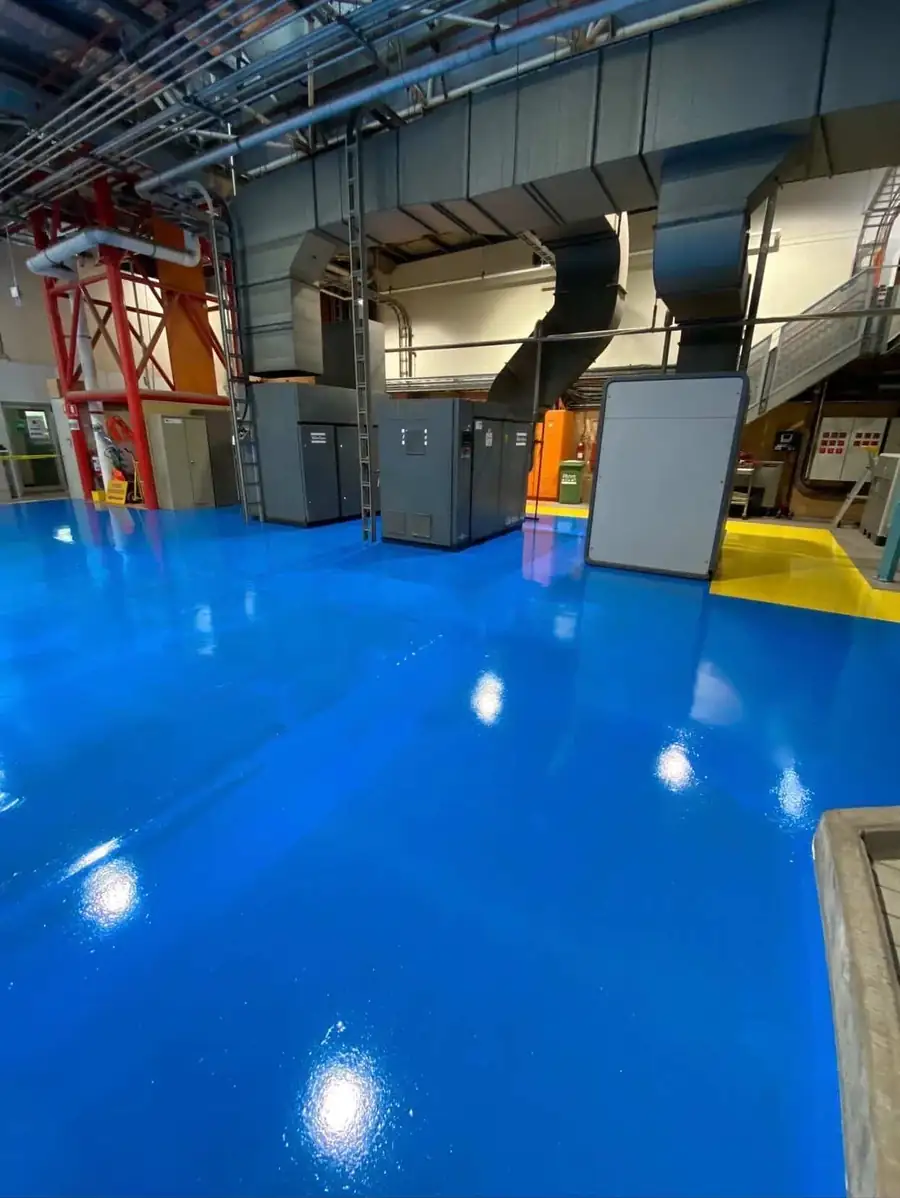
Commercial and industrial epoxy floors seal and strengthen bare concrete in warehouses, workshops, showrooms, kitchens and light-industrial buildings across Adelaide. The right system depends on traffic, chemicals, wash-down, temperature and how long the floor can be out of service, so specification starts with how the space is used, not with a colour chart.
Why bare commercial concrete becomes a problem
Uncoated concrete is porous. In a working building it absorbs oil, coolant, cleaning chemicals and water, then sheds fine dust every time a pallet jack or forklift crosses it. Dusting concrete contaminates stock and equipment, stains make a floor look neglected, and cracked or broken joints catch wheels and trip people. An epoxy or polyaspartic coating gives the slab a continuous, cleanable surface that is much harder to stain, easier to wash and quicker to inspect.
For businesses, floors are also a safety and compliance issue. Slip resistance, visible line marking, clearly defined walkways and hygienic coving at wall junctions all feed into workplace safety and, for food premises, inspections. A good coating specification covers those things as well as colour.
Systems we commonly specify
| System | Typical use | What to know |
|---|---|---|
| Solid-colour epoxy, thin film | Showrooms, offices, light storage, retail back-of-house | Cost-effective and easy to clean; not intended for heavy impact or aggressive chemicals. |
| Epoxy with aggregate or anti-slip | Workshops, loading areas, wet or oily zones | Adds texture for grip; slightly harder to clean than a smooth finish. |
| Heavy-duty build or self-levelling epoxy | Warehouses, factories, forklift routes | Thicker film resists wheel loads; slab condition and joint treatment are critical. |
| Polyaspartic or polyurethane topcoat | Areas with UV, fast turnaround or chemical exposure | Cures quickly and is UV-stable, but has a short working time and needs experienced application. |
| Epoxy with coved skirting | Kitchens, food preparation, cool rooms | Seamless floor-to-wall junction with no joint where moisture and bacteria collect. |
Line marking, zones and safety striping
A coated floor is an opportunity to organise the building. We can mark forklift lanes, pedestrian walkways, pallet bays, hazard zones and parking, using colours that contrast with the base coat. Marking is applied over the cured coating and sealed so that it wears at the same rate as the floor around it, rather than peeling away as a separate layer of paint.
Working around your business
Downtime is the cost most businesses worry about, so we plan commercial jobs around trading hours. Larger areas can be done in sections so that part of the building keeps operating, and fast-curing polyaspartic options can bring a floor back into light service in around a day, depending on conditions and product. After-hours and weekend starts are discussed on the site visit. The trade-off is that fast systems are less forgiving, so surface preparation and temperature control matter even more.
A realistic timeline always includes grinding, repairs, any moisture testing, the coating build and the cure, and it varies by area. We set out the sequence in writing, and the process guide shows what each stage involves.
Where we work around Adelaide
Adelaide's industrial and light-commercial districts are spread across the metro area. Northern buildings around Salisbury and the Edinburgh and Parafield corridor are often large distribution and manufacturing sheds with long forklift routes. The Lefevre Peninsula and Gillman side of Port Adelaide has marine, logistics and fabrication workshops. South of the city, Marion, Edwardstown and the Noarlunga and McLaren Vale region have trade units, cellar-door spaces and wine-production sheds that need hygienic, wash-down floors. We travel across South Australia, so regional sites are welcome too.
Slab condition, moisture and temperature
Commercial slabs are rarely perfect. Older buildings can have grease-contaminated concrete, previous coatings, saw cuts that have opened up, and moisture that moves up through the slab. We inspect for these before quoting, and where moisture is a risk we discuss testing and a suitable primer or vapour-control approach rather than hoping a thick coat will hold. A coating on a slab that is pushing moisture will blister regardless of how good the product is. The same caution applies to heat: slab temperature, humidity and dew point decide how and when a coating can be applied in an Adelaide summer, which is why the climate guide is worth reading before you pick a start date.
What to prepare before you ask for a quote
- Approximate floor area in square metres and the number of separate rooms or bays.
- What the floor is used for: forklifts, pallet jacks, foot traffic, chemicals, wash-down, hot or cold storage.
- Whether there are existing coatings, oil contamination or known cracks.
- How long the area can be closed and whether work must be done at night or on weekends.
- Any standards your insurer, landlord or food-safety auditor expects, such as slip rating or coving.
Send those details through the form or call 0421 443 213 and we will arrange a free on-site assessment. If you only need a quick feel for budget, see the epoxy cost guide, which gives labelled typical Australian ranges and explains what pushes a commercial quote up or down.
Warehouse, factory and industrial epoxy floors in Adelaide
Most commercial enquiries we get are for warehouse floor epoxy, factory floors and workshop coatings around Adelaide's industrial areas, from Wingfield, Regency Park and Port Adelaide to Lonsdale, Edinburgh and Salisbury South. The questions are usually the same: will it handle forklifts, how long will the floor be out of action, and can it be line-marked? The honest answer depends on the slab. A dusty, power-floated warehouse slab with saw-cut joints needs grinding, joint treatment and a build thick enough for wheel loads. A light-storage area may only need a thin dust-proofing coat. Food areas and wash-down rooms need hygienic coving and a slip-rated texture.
We give a written specification that lists preparation, film build, topcoat, line marking and cure times, so you can compare it fairly against other quotes, and we plan staged or after-hours work where a business cannot close.
System thickness: matching the build to the traffic
"Epoxy" covers very different floors, from a thin dust-proofing coat to a trowelled screed several millimetres thick. Thickness is what lets a floor survive forklift wheels, dragged pallets and hot wash-downs, so it is the first thing to compare between quotes. The ranges below are typical industry figures to help you read a specification; the right build for your site comes from the slab assessment.
| System | Typical build | Suits | Limits |
|---|---|---|---|
| Roller-applied epoxy coating | About 0.2 to 0.5 mm (200 to 500 microns) over two coats | Storage, plant rooms, light foot and trolley traffic, dust-proofing | Shows slab defects; wears through faster under forklifts |
| High-build or broadcast epoxy | About 1 to 3 mm | Workshops, warehouses with forklifts, textured anti-slip areas | Texture is harder to mop than a smooth floor |
| Self-levelling epoxy | About 2 to 4 mm | Smooth, seamless floors for production, clean areas and pallet jacks | Needs a flat, well-prepared slab and more cure time |
| Polyurethane cement (PU cement) | Often about 4 to 9 mm | Commercial kitchens, food processing, hot wash-down and thermal shock | Matte industrial look; higher cost; specialist install |
| Fast-cure polyaspartic or MMA systems | Varies by system | Retail and hospitality with overnight or weekend shutdown windows | Very short working time; strong odour with MMA |
Commercial kitchens and food premises in South Australia
Food businesses have an extra layer of requirements. The Food Standards Code (Standard 3.2.3, Food Premises and Equipment) requires floors in food premises to be able to be effectively cleaned, to be unable to absorb grease, food particles or water, and, where appropriate, to be laid so there is no ponding of water. In practice that means a seamless resin floor, a coved junction where the floor meets the wall, sealed penetrations around pipes and drains, and falls toward the drains. Your council's environmental health officer is the authority on what your premises needs, so it is worth sharing the floor specification with them before work starts.
Standard epoxy suits dry food storage and front-of-house areas. Where floors see boiling water, steam cleaning, oven spills or cold-room doors opening onto hot kitchens, polyurethane cement is usually the better choice because it tolerates thermal shock that can crack or debond a thin epoxy. Kitchens are typically done in zones overnight or across a planned closure so trading can resume quickly.
Slip resistance in commercial areas
Australian slip resistance is classified under AS 4586, most commonly using the wet pendulum test (P ratings from P0 to P5, higher means more grip) and, for some industrial and wet-process areas, an oil-wet ramp test (R ratings). The rating a space needs depends on how it is used: a dry office corridor, a ramp, a cool room and a wash-down area all differ. On a resin floor, grip is adjusted by broadcasting aggregate into the coat and by how much topcoat goes over it. More texture means more grip but more effort to clean, so we talk through that balance rather than promising a number that has not been tested on your finished floor.
Frequently asked questions
Can epoxy handle forklifts?
A heavy-duty system on a sound slab can, but the build thickness, slab condition and joint treatment all have to suit the loads. We specify to the traffic, not to a generic product.
How quickly can a commercial floor be back in service?
It depends on the system and conditions. Fast-curing polyaspartic options can allow light traffic in around a day; thicker builds take longer. We give you a written return-to-service schedule.
Do you do food-grade floors with coving?
Yes, hygienic systems with coved skirting are one of the services we offer for kitchens, food preparation and similar spaces. We discuss the standard your premises must meet before specifying.
Is industrial epoxy different from garage epoxy?
Usually yes. Industrial systems are built thicker or with harder topcoats for forklifts, pallet jacks and chemicals, and may include coving and line marking. A household garage system is designed for cars, hot tyres and foot traffic.
Can you epoxy a warehouse floor in sections?
Often, yes. We can stage work by bay or zone and use faster-curing topcoats so parts of a warehouse stay in use. The schedule is agreed in writing before work starts.
How thick should a warehouse epoxy floor be?
It depends on the traffic. Light storage may only need a roller-applied coating of a few hundred microns, while forklift aisles usually call for a high-build or broadcast system of roughly 1 to 3 mm. We specify the build after looking at the slab, the wheel types and the loads.
What is the difference between epoxy and polyurethane cement flooring?
Epoxy is a hard resin coating suited to most warehouses, workshops and showrooms. Polyurethane cement is a thicker, cement-filled resin screed that tolerates hot water, steam cleaning and sudden temperature changes, which makes it the usual choice for commercial kitchens and food processing.
Do commercial kitchen floors in South Australia need coving?
The Food Standards Code requires food premises floors to be effectively cleanable and unable to absorb grease, food or water. A coved floor-to-wall junction is the common way to meet that at the edges. Your council environmental health officer confirms the requirements for your premises.
Keep reading
Ready to talk about your project? Call or text 0421 443 213, Monday to Saturday, 7:00 AM to 8:00 PM, or use the free quote form.
Call 0421 443 213