Last updated: October 2026
Quick answer
Polished concrete grinds and densifies the slab itself, so there is no film to peel, but it needs a good-quality slab and it can stain. Epoxy coats the slab, so it can cover patches, stains and colour variation, with a wider range of colours, but it is a film that can wear or peel if it is poorly installed. For rough, patched or oil-stained slabs, epoxy is usually the more forgiving route; for a high-quality slab in a living area, polishing can be excellent.
Two different ideas
Polished concrete is a mechanical process: diamond grinding in progressively finer grits, a chemical densifier that hardens the surface, and a final polish to the desired sheen. There is no coating on top. Epoxy is a chemical coating applied over ground concrete, forming a continuous resin film. Both can look excellent. They are suited to different slabs and different expectations.
Slab quality decides a lot
A polished floor shows everything that is in the concrete: aggregate pattern, trowel marks, patches, cracks and colour variation. If the slab is a clean, well-finished, uniform pour, polishing can look beautiful. If it has been patched, stained with oil or built from several different pours, polished concrete often looks blotchy. Epoxy covers variation because the colour comes from the resin, not the slab.
Comparison
| Factor | Epoxy coating | Polished concrete |
|---|---|---|
| Typical Australian range | About A$55 – A$180 per m² depending on system | Often about A$60 – A$150 per m² depending on grind level and slab (market range) |
| Hides patches and stains | Yes, to a good extent | No; shows slab imperfections |
| Colour options | Wide: solids, flake, metallic | Limited to concrete tones, dyes and aggregate |
| Risk of peeling | Possible if poorly prepared | None; no film |
| Stain resistance | High with a sealed topcoat | Moderate; can etch from acids |
| Grip when wet | Adjustable with texture | Can be slippery when polished high |
| Heat comfort | Dark colours absorb heat outdoors | Neutral |
| Repair | Recoat or patch | Re-grind and re-polish |
Garages, studios and living areas
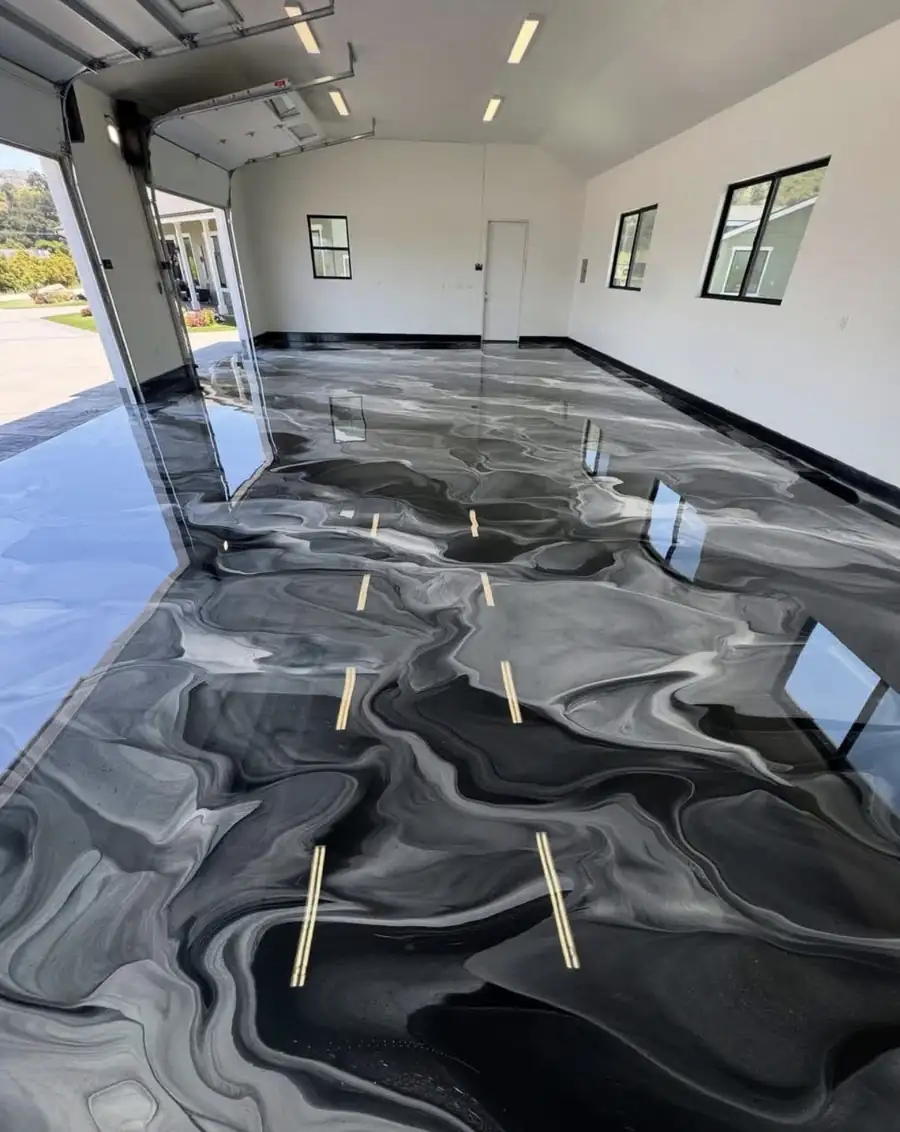
In garages, epoxy is generally the more practical choice. Oil, tyre marks and acid from batteries can etch or stain polished concrete, while a sealed epoxy surface resists them. In living areas and studios, polished concrete has a clean, modern look and does not hold any film that could wear. For renovated homes in areas like Norwood and Unley, we are often asked whether a metallic epoxy can achieve a polished-stone look without grinding and densifying the entire slab; in many cases it can, particularly where the slab is not perfectly even.
Maintenance and long-term wear
Polished concrete is low maintenance: sweep, damp-mop and occasionally re-seal or burnish. It can be re-ground and re-polished if scratched. Epoxy is also easy to maintain but can be scratched by dragged metal and may need a refresh coat in a decade or so, depending on use. The exact timeline depends heavily on the preparation and the topcoat chosen.
How to decide
- Rough, patched or oil-stained slab: epoxy.
- Excellent, even slab in a living area where you love the concrete look: polishing.
- Garage with vehicles: epoxy, usually flake for grip and tyre-mark hiding.
- Feature space that needs colour: metallic epoxy; see metallic floors.
- Tight budget with decent slab: consider a professionally installed solid-colour epoxy; see the cost guide.
We install epoxy rather than polish, so we will tell you honestly if your slab sounds like a better candidate for polishing. A free on-site assessment lets us look at the concrete before you decide. For more on how the two epoxy styles compare, see flake versus metallic.
Common myths about both options
- Myth: polished concrete never needs maintenance. Reality: it still needs cleaning, and may need resealing.
- Myth: epoxy is only for garages. Reality: decorative epoxy is used in homes, showrooms and hospitality.
- Myth: any slab can be polished. Reality: low-quality or patched slabs often polish poorly.
- Myth: epoxy always peels. Reality: peeling is usually a preparation or moisture issue, not inevitable.
The best choice depends on the slab, the budget and how you want the room to feel. If you are unsure, we are happy to look at the concrete and give you an honest view of which route is likely to give a better result.
Frequently asked questions
Is polished concrete cheaper than epoxy?
It depends on the slab and the polish level. Market ranges overlap, and poor slab condition can raise the cost of polishing.
Which is better for a garage?
Epoxy is usually more practical because it resists oil, tyre marks and acids better than polished concrete.
Can epoxy imitate polished concrete?
A metallic or solid-colour gloss epoxy can approximate the look, especially where the slab is patchy.
Keep reading
Ready to talk about your project? Call or text 0421 443 213, Monday to Saturday, 7:00 AM to 8:00 PM, or use the free quote form.
Call 0421 443 213