Last updated: October 2026
Quick answer
Adelaide has a Mediterranean climate: hot, dry summers with regular 40-degree days, extreme UV, mild wet winters and cool damp mornings. That cycle shortens working times for epoxy, yellows unprotected clear coats in sunlight, makes slab temperature a daily scheduling issue and tests slabs on reactive clay. Good results come from early starts, thorough diamond grinding and a UV-stable topcoat on exposed areas.
The Adelaide climate in one paragraph
Adelaide is one of the driest Australian capitals, with annual rainfall typically around 500 to 550 millimetres, most of it falling between May and September. Summers are long and hot, with heatwaves where several days in a row exceed 40 degrees. Winters are mild but can be damp, with cool mornings and occasional frosts in the Hills. The UV index in summer is extreme. Each of those facts affects how and when an epoxy floor can be installed.
Heat and working time
Epoxy and polyaspartic resins are chemical reactions. The warmer the mix, the faster it reacts and the shorter the working time. A bucket left in the sun can go off in minutes, leaving roller marks, ridges or a skin that traps bubbles beneath it. Coating a slab that is hot from the afternoon sun can produce pinholes as air in the concrete expands and rises through the resin. For those reasons we start jobs early in the morning, keep materials shaded, and sometimes split a large floor into sections that can be finished before the heat rises.
Heat also affects the people doing the work. Safe site practices in hot weather are part of why a quote in a heatwave might include a later start or a different schedule, and why the cheapest-looking summer booking is not always the best plan.
UV: why clear epoxy yellows in the sun
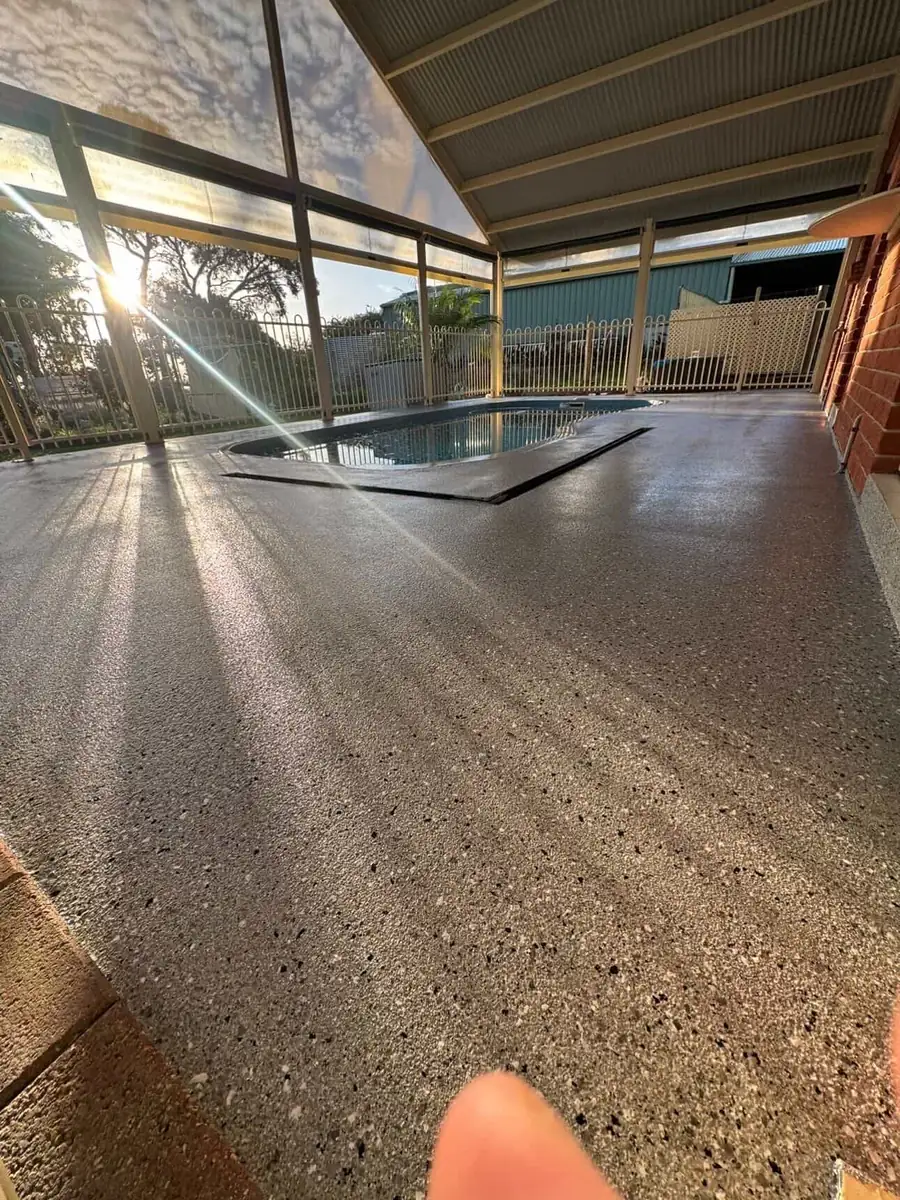
Ordinary epoxy resin is not UV stable. In direct sun it ambers and chalks, with gloss falling away over months. A garage floor inside a closed building is mostly safe, but any area that receives sun through a roller door or open front, such as a threshold, carport or alfresco area, needs a different topcoat. UV-stable polyaspartic or aliphatic polyurethane topcoats are designed to keep clarity and colour under sunlight. We discuss this on the outdoor epoxy page and in epoxy versus polyaspartic.
Slab temperature, dew point and winter mornings
Winter in Adelaide brings the opposite problem. A cold, damp slab at dawn can sit close to dew point, which is the temperature at which moisture condenses on a surface. Coating below roughly three degrees above dew point risks a hazy, blushed film and poor bonding. We check slab and air temperature with a thermometer and a humidity reading rather than relying on a weather forecast, and in cooler months a later start is common.
Reactive clay and cracking
Much of the Adelaide plains sits on reactive clay that swells when wet and shrinks when dry. Slabs move seasonally, and cracks that are invisible in March can open in September. We repair cracks with flexible fillers and treat control joints as joints rather than covering them with rigid epoxy, and we talk through which lines might return. Choosing a finish with texture, such as flake, also helps hide small movements.
Diamond grinding: why it is the right way to prepare concrete
Epoxy bonds mechanically to concrete. A diamond grinder with the correct segments removes the weak surface layer, opens the pores and leaves a profile that resin can key into. Acid etching and light sanding leave a poor profile and are not a substitute. Grinding is dusty, and the dust contains respirable crystalline silica, a hazard regulated under Australian work health and safety rules. Good practice means a shroud and extraction on the grinder, an industrial vacuum rated for fine dust, protective equipment and a clean-up before any coating is rolled.
Grinding depth, diamond grit and speed all depend on the slab. A hard, power-floated shed slab needs a more aggressive approach than a soft, weak garage floor, where too much grinding can create a wavy surface. A thorough assessment on site is what sets those choices.
Coastal and Hills variations
Conditions differ across the metropolitan area. Beachside suburbs such as Glenelg add salt and sand. The Hills near Mount Barker are cooler and wetter, with frost in winter. The northern plains around Gawler are hotter and drier. We adjust scheduling and specification to the location instead of using one approach for the whole state.
A seasonal planning cheat sheet
| Season | Main challenge | What we do |
|---|---|---|
| Summer (Dec–Feb) | Heat, short pot life, hot slabs, extreme UV | Early starts, shaded materials, UV-stable topcoats on exposed areas |
| Autumn (Mar–May) | First rains, variable humidity | Check forecasts and moisture; often an ideal window for garages |
| Winter (Jun–Aug) | Cold slabs, dew point, longer cure | Later starts, heating where appropriate, longer cure windows |
| Spring (Sep–Nov) | Windy days, pollen, rising temperatures | Protect wet coats from dust, watch for early heat |
Frequently asked questions
Can epoxy be applied in an Adelaide heatwave?
It can be, but heat shortens working time and raises the risk of bubbles and uneven film, so we start early, protect materials and sometimes reschedule.
Why does clear epoxy turn yellow outdoors?
Epoxy resin reacts to ultraviolet light, causing ambering and chalking. UV-stable topcoats are used where sun reaches the floor.
Do reactive clay soils matter for garage floors?
Yes. Movement in the soil can crack the slab. We repair cracks with flexible materials and explain which may move again.
Is concrete grinding really necessary?
Yes. It removes the weak surface, opens the concrete and creates the profile that epoxy bonds to. Acid etching is not an equivalent.
For how heat, UV and reactive clay play out in a typical home garage, see garage epoxy flooring in Adelaide.
Keep reading
Ready to talk about your project? Call or text 0421 443 213, Monday to Saturday, 7:00 AM to 8:00 PM, or use the free quote form.
Call 0421 443 213